
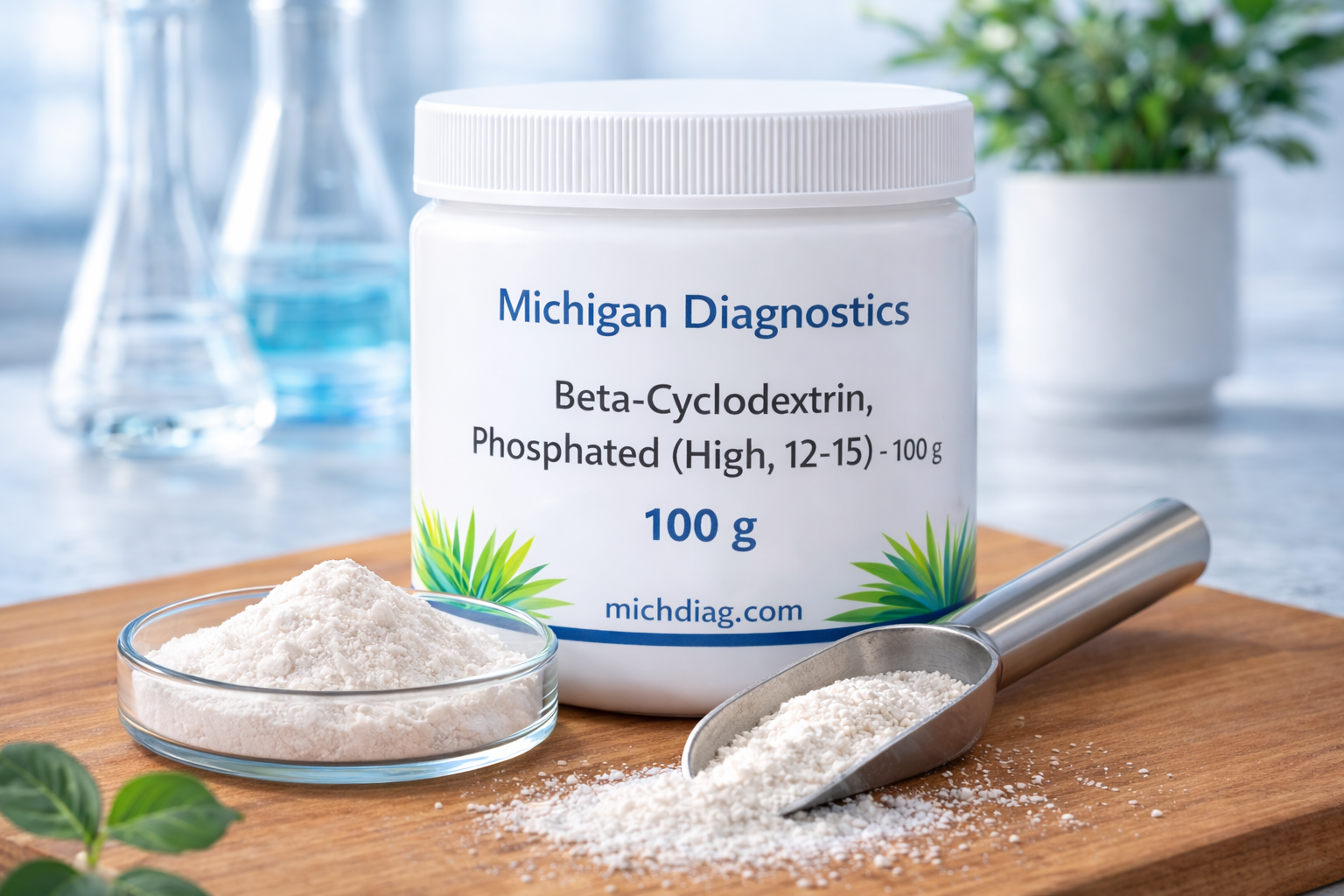

Description
Beta Cyclodextrin Phosphated High (DS 12–15)
Beta-cyclodextrin, phosphated (high degree of substitution 12–15), is an advanced cyclodextrin derivative engineered to provide maximum aqueous solubility, enhanced buffer compatibility, and improved performance in complex biochemical and pharmaceutical systems. By extensively phosphorylating the hydroxyl groups of native beta-cyclodextrin, this material achieves a highly hydrophilic profile while maintaining the structural integrity and widely utilized cavity size of beta-cyclodextrin.
At Michigan Diagnostics LLC, we manufacture high-purity beta cyclodextrin phosphated (DS 12–15) with strict control over substitution levels to ensure consistent performance across research and industrial applications. Each batch is produced under rigorous quality standards and supplied with a Certificate of Analysis (COA), supporting reproducibility and reliability.
Structural and Functional Characteristics
Beta-cyclodextrin is composed of seven α-1,4-linked glucose units arranged in a toroidal structure, forming a hydrophobic cavity approximately 6.0–6.5 Å in diameter. This cavity size is ideal for encapsulating a wide range of small to medium-sized hydrophobic molecules, making beta-cyclodextrin one of the most widely used cyclodextrins in pharmaceutical and biochemical applications.
When highly phosphorylated (DS 12–15), the molecule becomes significantly more hydrophilic, enabling excellent solubility in aqueous and buffered systems. Unlike sulfated cyclodextrins, which introduce strong electrostatic interactions, phosphated cyclodextrins provide a more moderate and controlled anionic character. This makes them particularly suitable for applications where compatibility with biological systems and stability in solution are more important than strong binding interactions.
At high levels of phosphorylation, beta-cyclodextrin transitions toward functionality dominated by solubility, dispersion, and formulation stability, while still retaining some inclusion complex capability.
Key Properties
- Degree of Substitution (DS): 12–15 phosphate groups per molecule
- Charge Profile: Mild to moderately anionic
- Water Solubility: Extremely high
- Cavity Size: ~6.0–6.5 Å
- Functional Mode: Aqueous compatibility dominant
- Buffer Compatibility: Excellent
These characteristics make high-phosphated beta cyclodextrin particularly effective in water-based systems and complex formulations.
Pharmaceutical and Drug Delivery Applications
Beta-cyclodextrin phosphated (high DS) is widely used in pharmaceutical research and formulation development where high solubility and stability are required. Its cavity size allows encapsulation of many commonly used drug molecules, while its high hydrophilicity ensures efficient dispersion.
Applications include:
- Solubilization of poorly water-soluble active pharmaceutical ingredients (APIs)
- Stabilization of sensitive drug compounds and biologics
- Formulation of injectable and aqueous drug delivery systems
- Reduction of aggregation in protein and peptide formulations
- Controlled release systems for improved therapeutic performance
The enhanced compatibility with aqueous environments makes this material particularly valuable in formulations intended for biological systems.
Biochemical and Enzyme Applications
High-phosphated beta cyclodextrin is especially useful in biochemical systems where stable, homogeneous solutions are required without strong interference from electrostatic interactions.
Applications include:
- Enzyme stabilization in buffered systems
- Protein-compatible formulations
- Reduction of nonspecific binding
- Enhancement of reagent solubility
- Optimization of biochemical assays
Because the charge profile is moderate rather than highly ionic, it supports stable interactions without disrupting biological activity.
Diagnostic and Analytical Applications
Beta-cyclodextrin phosphated (high DS) is well suited for use in diagnostic and analytical systems where consistency and stability are critical.
Applications include:
- ELISA and immunoassay systems
- Chemiluminescent assay stabilization
- Analytical separation and chromatography
- Reagent stabilization in diagnostic workflows
- Support for high-sensitivity laboratory assays
Performance Advantages in Complex Formulations
One of the key advantages of beta-cyclodextrin phosphated (high DS 12–15) is its ability to maintain solubility and stability in complex formulations. The high degree of phosphorylation significantly reduces the risk of precipitation, even in high-concentration or multi-component systems.
This makes it particularly useful in:
- High-load pharmaceutical formulations
- Biologic and protein-based systems
- Multi-component diagnostic reagents
- Long-term storage applications requiring stability
Additionally, the consistent substitution profile ensures predictable behavior across batches, which is essential for scaling from research to production.
Why Choose Michigan Diagnostics
Selecting a reliable beta cyclodextrin phosphated supplier in the USA is critical for ensuring quality and consistency.
Michigan Diagnostics offers:
- Tight DS control (12–15) for reproducible performance
- High-purity material with full COA documentation
- US-based manufacturing with fast 2–3 day shipping
- Custom synthesis and bulk supply options
- Technical support for formulation and research
Packaging and Availability
Beta-cyclodextrin phosphated (high DS 12–15) is available in:
- Research quantities
- Pilot-scale batches
- Bulk commercial volumes
Custom packaging and documentation are available upon request.
Order Beta Cyclodextrin Phosphated (High DS 12–15)
If you are looking to buy beta cyclodextrin phosphated high (DS 12–15), Michigan Diagnostics provides a dependable, high-quality solution with fast delivery and expert support. Contact us today to request pricing or discuss your application needs.
Reviews
There are no reviews yet.