
What Is an HRP Substrate?
Horseradish peroxidase (HRP) is the most widely used enzyme label in immunoassays, including ELISA, lateral flow assays, and Western blots. To generate a detectable signal, HRP requires a substrate — a reagent that HRP oxidizes to produce a measurable color change, fluorescent signal, or chemiluminescent glow.
Choosing the right HRP substrate directly affects your assay’s sensitivity, dynamic range, and workflow. This guide focuses on soluble chromogenic substrates — the most common format for quantitative ELISA — and specifically on TMB (3,3′,5,5′-tetramethylbenzidine), the gold standard for HRP-based colorimetric detection.
Types of HRP Substrates: A Quick Overview
Not all HRP substrates are the same. Here is a summary of the major categories:
| Substrate Type | Signal | Common Use | Detection Range |
|---|---|---|---|
| TMB (chromogenic) | Blue to Yellow (colorimetric) | ELISA (plate-based) | Broad; most widely used |
| OPD (chromogenic) | Orange (colorimetric) | ELISA (older format) | Lower sensitivity than TMB |
| ABTS (chromogenic) | Green (colorimetric) | ELISA, lower sensitivity assays | Moderate |
| pNPP (chromogenic) | Yellow (colorimetric) | Alkaline phosphatase (AP) assays | AP-specific |
| DAB (insoluble) | Brown precipitate | IHC, Western blot | High contrast, permanent |
| ECL / Luminol | Chemiluminescent | Western blot, high-sensitivity ELISA | Very high sensitivity |
For quantitative plate-based ELISA, TMB is the preferred choice due to its excellent sensitivity, wide linear range, safety profile, and ease of use.
Why TMB Is the Gold Standard for ELISA
TMB has been the dominant HRP substrate in immunoassays since the 1980s for good reason. Compared to older substrates like OPD and ABTS, TMB offers higher sensitivity, producing a stronger signal per unit of HRP enzyme to enable detection of low-abundance analytes. It also provides a wider dynamic range with a linear response across a broad concentration range for accurate quantification. Unlike OPD (a suspected carcinogen), TMB is non-carcinogenic and safe to handle under standard lab conditions. Addition of sulfuric or phosphoric acid stop solution converts the blue reaction product to a stable yellow color read at 450 nm, and modern single-bottle TMB formulations are shelf-stable for 12+ months at refrigerated temperatures.
Single-Bottle vs. Two-Bottle TMB Substrate Systems
Two-Bottle (Two-Component) Systems
Traditional TMB kits include two separate reagents: a TMB concentrate (in DMSO or another organic solvent) and a peroxide/buffer solution that must be mixed immediately before use. While this approach can extend the shelf life of each component individually, it introduces variability from mixing errors, requires careful pipetting ratios, and adds steps to your workflow.
Single-Bottle (Ready-to-Use) Systems
Modern single-bottle TMB substrates come pre-formulated and ready to use — no mixing, no preparation. The TMB and peroxide are stabilized in a single solution optimized for consistent performance. This is the preferred format for high-throughput labs and routine ELISA workflows because it eliminates lot-to-lot mixing variability, reduces hands-on preparation time, minimizes pipetting errors, and provides consistent background and signal across runs.
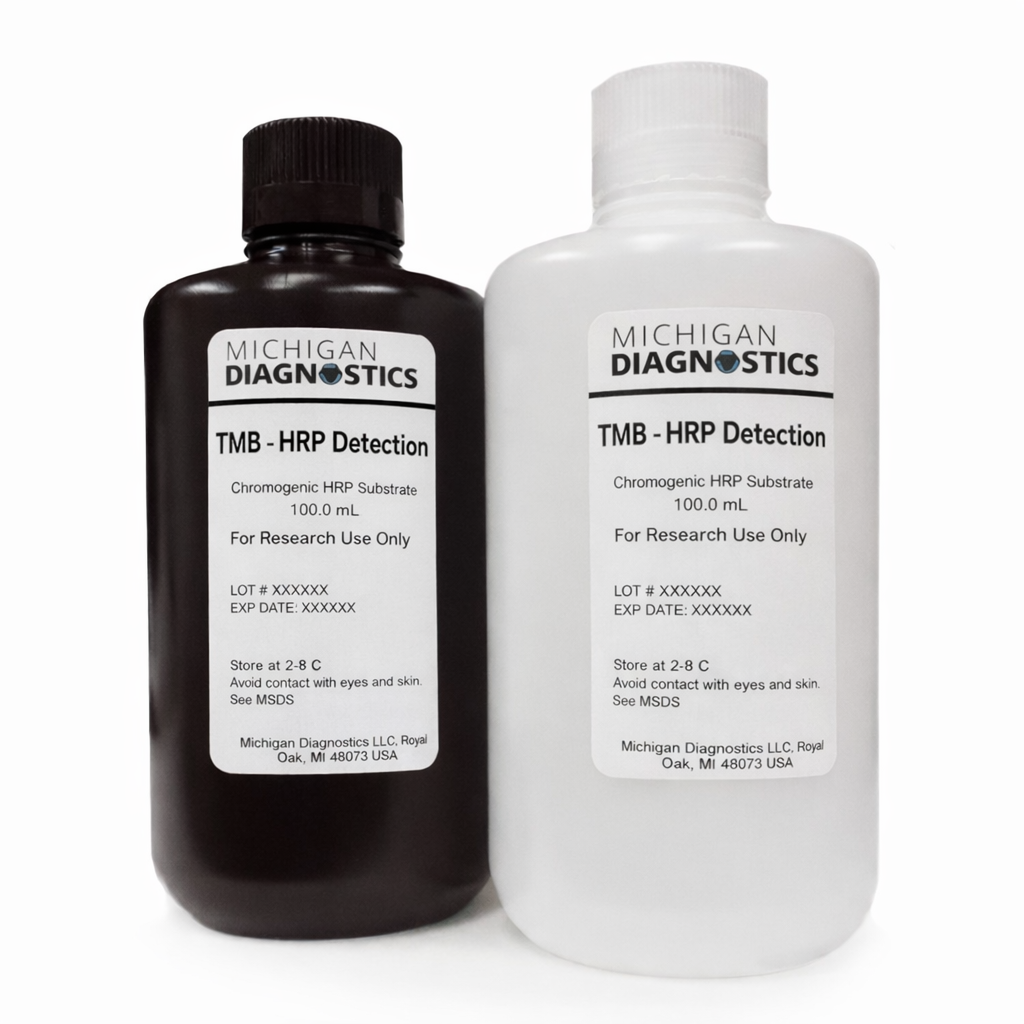
Michigan Diagnostics’ Single-Bottle Chromogenic HRP Substrate (TMB) is a ready-to-use, pre-formulated solution optimized for sandwich and competitive ELISA. No mixing required — just dispense, incubate, stop, and read.
Key Specifications to Compare When Choosing a TMB Substrate
When evaluating TMB substrates from different suppliers, pay attention to these critical parameters.
1. Detection Wavelength and Stop Solution Compatibility
All TMB substrates produce a blue color during the HRP reaction (peak absorbance at ~370 nm and ~652 nm). Adding an acid stop solution converts this to a stable yellow product read at 450 nm. Verify your substrate is compatible with standard sulfuric acid (H2SO4) or phosphoric acid (H3PO4) stop solutions to ensure full color conversion.
2. Sensitivity and Signal-to-Background Ratio
A high-quality TMB substrate should give a strong OD signal with minimal background on negative controls. Look for substrates validated on standard ELISA plate formats (Nunc MaxiSorp, Costar, etc.) and confirm that the dynamic range fits your analyte concentration range.
3. Shelf Life and Storage Conditions
Most quality TMB substrates are stable for 12 months when stored at 2–8°C, protected from light. Avoid substrates that require freezing — freeze-thaw cycles can degrade the peroxide component and reduce performance. Michigan Diagnostics’ TMB substrate is rated for 12-month stability at 2–8°C.
4. Solvent Composition (DMF/DMSO-Free)
Some TMB formulations use DMF (dimethylformamide) or DMSO (dimethyl sulfoxide) as co-solvents. While effective, these solvents add disposal considerations and can be irritating. Many labs prefer DMF/DMSO-free formulations for a simpler handling and waste stream profile.
5. Volume and Cost Per Test
TMB substrate is typically dispensed at 100 µL per well in a 96-well plate format. A 1000 mL bottle provides approximately 10,000 individual well reactions — enough for roughly 104 full plates. When comparing costs, calculate price per mL or price per 1000 wells to make an apples-to-apples comparison across suppliers. Michigan Diagnostics offers 1000 mL of ready-to-use TMB substrate at a significant savings compared to major catalog suppliers, with US manufacturing and a certificate of analysis (COA) included with every lot.
6. Regulatory and Quality Documentation
For regulated assay environments (clinical labs, GMP manufacturing, diagnostic kit production), confirm that your TMB substrate supplier provides a Certificate of Analysis (COA) with lot-specific QC data confirming performance, a Safety Data Sheet (SDS) required for lab safety compliance, US or ISO-compliant manufacturing important for supply chain reliability, and OEM/bulk options for kit manufacturers who need custom volumes or private-label packaging.
TMB Substrate Comparison: What the Major Suppliers Offer
The table below summarizes key features across commonly used TMB HRP substrate products:
| Supplier | Format | Volume | Notable Feature |
|---|---|---|---|
| Michigan Diagnostics | Single-bottle, ready-to-use | 1000 mL | US-manufactured, COA included, OEM available, competitive pricing |
| ThermoFisher Scientific | Single-bottle (multiple formulations) | Up to 1 L | Wide catalog selection; Ultra-TMB for higher sensitivity |
| Sigma-Aldrich (MilliporeSigma) | Single-bottle | 100–500 mL | CAS-referenced, catalog integration |
| Abcam | Single-bottle | 100–500 mL | Validated in publications; detailed protocol support |
| MOSS Bio | Multiple formulations (HK, US, E, ES) | Evaluation packs + bulk | Specialty formulations; extended stability on some products |
Note: Pricing and availability subject to change. Contact suppliers directly for current quotes.
Step-by-Step Protocol: Using TMB Substrate in a Sandwich ELISA
Here is a general-purpose protocol for using ready-to-use TMB substrate in a standard sandwich ELISA.
- Equilibrate the TMB substrate to room temperature (18–25°C) for at least 30 minutes before use. Cold substrate can slow the reaction and reduce signal.
- Complete all prior ELISA steps — coat, block, primary antibody, wash, HRP-conjugated secondary antibody, final wash. Ensure plates are thoroughly washed to remove unbound HRP conjugate before adding substrate.
- Dispense 100 µL of TMB substrate per well. Use a multichannel pipette or liquid handler for consistency across the plate.
- Incubate at room temperature in the dark for 5–30 minutes, depending on assay sensitivity requirements. Monitor color development — a gradient of blue color should appear in positive wells.
- Stop the reaction by adding 100 µL of 0.5 M H2SO4 (sulfuric acid stop solution) or 1 M H3PO4 (phosphoric acid) per well. The solution will turn from blue to yellow immediately.
- Read absorbance at 450 nm within 30 minutes of stopping the reaction. Use a 620 nm or 630 nm reference wavelength subtraction if your plate reader supports dual-wavelength reading to correct for optical imperfections.
Troubleshooting Common TMB Substrate Issues
High Background / Blue Color in Negative Controls
This usually indicates insufficient washing before substrate addition. Ensure your wash buffer contains 0.05% Tween-20, perform at least 3–5 wash cycles, and aspirate wells completely between washes. It can also indicate TMB substrate contaminated with metal ions — use clean pipettes and avoid contact with metal instruments.
Weak or No Signal in Positive Controls
Check that your TMB substrate has not expired and has been stored correctly (2–8°C, away from light). Confirm HRP conjugate activity with a separate control. Ensure substrate was equilibrated to room temperature before use. If the substrate appears blue in the bottle before use, it has been oxidized and should be discarded.
Incomplete Color Conversion After Stop Solution
If wells remain blue or greenish after adding stop solution, the acid may be too dilute or the stop solution volume may be insufficient. Ensure you are using the correct stop solution concentration and that it is thoroughly mixed into each well by gently tapping the plate.
Substrate Turned Blue Before Use
TMB substrate naturally oxidizes over time, especially if exposed to light, heat, or metal contamination. A lightly blue-tinted substrate may still be usable but will show elevated background. Deeply blue substrate should be discarded. Always store tightly capped at 2–8°C and avoid introducing contaminants by using clean, disposable plasticware.
Frequently Asked Questions About TMB HRP Substrates
Can I use TMB substrate for Western blots?
No — soluble TMB is formulated for plate-based ELISA only. For Western blots, use an insoluble HRP substrate such as DAB (diaminobenzidine) for chromogenic detection, or an ECL (enhanced chemiluminescence) substrate for luminescent film or digital imaging detection.
What stop solution should I use with TMB?
The most common stop solution is 0.5 M sulfuric acid (H2SO4). Phosphoric acid (1 M H3PO4) is also commonly used and produces a slightly more stable yellow color. Do not use HCl — hydrochloric acid can cause precipitation rather than a clean color shift.
How long is TMB substrate stable once opened?
Properly stored (capped, refrigerated at 2–8°C, protected from light), opened TMB substrate remains stable until its labeled expiration date. Avoid contamination by using clean, dedicated pipettes and never returning unused substrate to the original bottle.
Can I use TMB substrate for lateral flow or point-of-care assays?
Soluble TMB is not typically used in lateral flow strips — those platforms use colloidal gold or latex particle labels rather than enzyme-based detection. However, TMB can be used in membrane-based dot-blot or slot-blot assays.
Is TMB safe to handle?
TMB is considered non-carcinogenic and relatively safe compared to older chromogenic substrates like OPD. Standard laboratory precautions apply — gloves, eye protection, and proper disposal per your institution’s chemical waste guidelines. Always refer to the SDS for your specific product.
Ready to Order? Michigan Diagnostics TMB Substrate
Michigan Diagnostics manufactures a high-quality, single-bottle TMB HRP substrate in the USA, available in 1000 mL volume. It is ready-to-use with no mixing required, optimized for sandwich and competitive ELISA formats, detected at 450 nm after acid stop, stable at 2–8°C for 12 months, US-manufactured with Certificate of Analysis (COA) included, and available for OEM and bulk supply for kit manufacturers with fast 2–3 day shipping.